
Your Office Space Is Either Fueling Your Culture or Killing It
CEO Series | Week 1 of 7
By Chris Rohrer & Pete Kostroski | Co-Owners
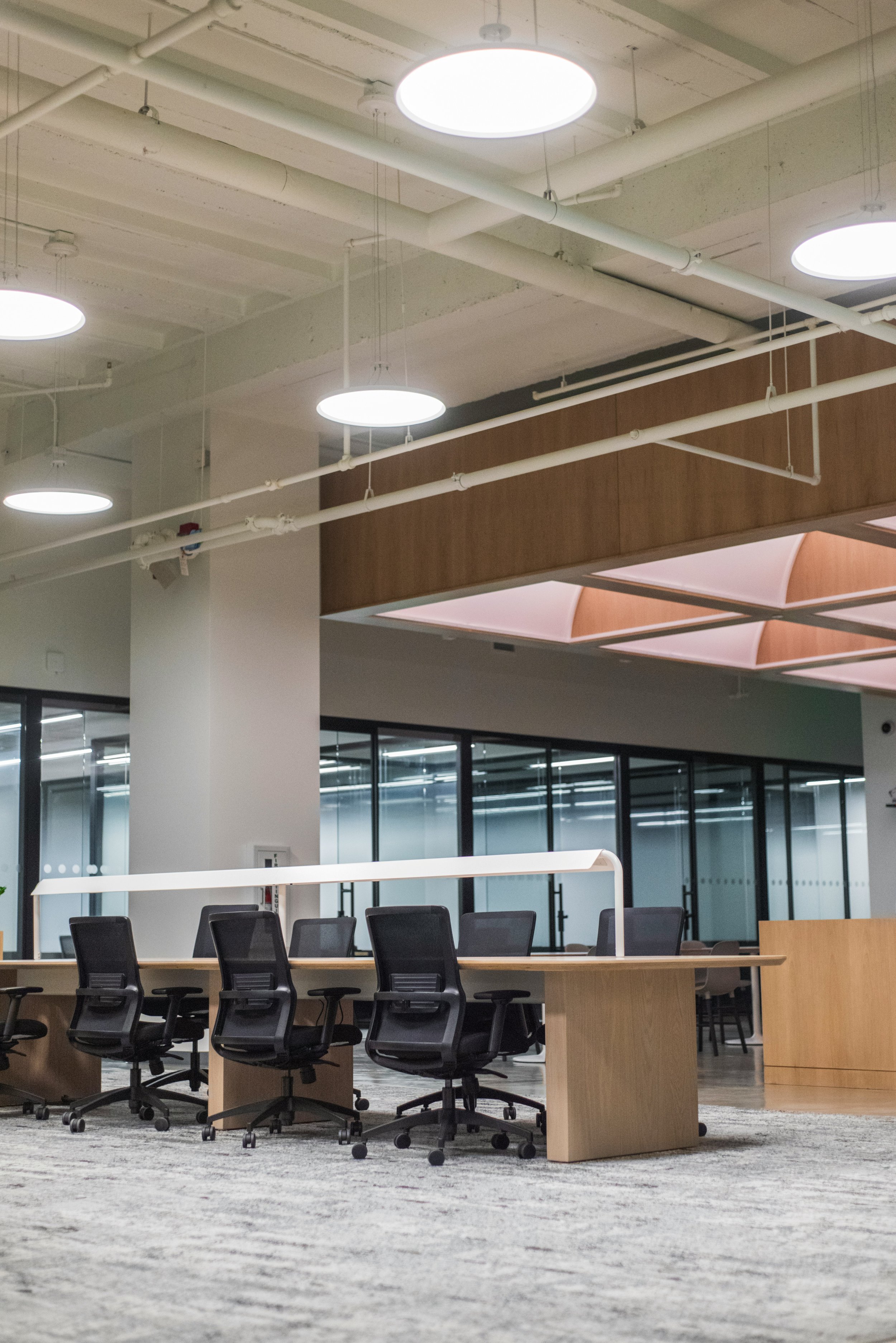
I’ve walked through a lot of office spaces over the years. Some of them are remarkable, the kind of space that makes you want to stay, to show up, to do your best work. And some of them are quietly working against the very company that pays rent on them every month.
The ones that concern me most aren’t the bad ones. They’re the neutral ones. The ones where leadership has essentially said, without meaning to: “This is just a place we work.”
Space communicates before anyone opens their mouth
When a prospective hire walks into your office for the first time, they’re reading the room. Is this place invested in? Does it feel like somewhere people want to be? Does the environment reflect the kind of company leadership says this is?
The physical space answers those questions before you do. And in a market where top talent has options, those first impressions carry real weight.
This isn’t about aesthetics. It’s not about spending money on trendy furniture or an espresso bar. It’s about intentionality. Does the space reflect how your team actually works? Does it give people room to collaborate when they need to, and to focus when they don’t? Does it feel like an investment in the people who show up every day, or does it feel like overhead?
The building itself is part of the offer
Something that doesn’t get enough attention in this conversation: the building itself carries leverage. Not just the space you lease but the building you’re in, what it offers, and where it sits.
A well-located building, walkable to lunch options, close to where your people live, accessible by transit or major corridors, removes friction from the daily experience of showing up. That matters more than most CEOs weight it. Employees notice commute time. They notice whether there’s a place to grab coffee or take a walking meeting. They notice whether the building feels like it belongs to a company that’s going somewhere.
Building amenities like a fitness center, conference facilities, outdoor space, on-site food, quality common areas, extend what your office can offer without requiring you to build or maintain it yourself. These aren’t perks in the traditional sense. They’re infrastructure that supports how people work and how they feel about coming in. And in a competitive talent market, they show up in conversations with candidates whether or not leadership is intentional about them.
The point isn’t to chase amenities for their own sake. It’s to understand that your real estate decision is a bundle, your space, your building, your location, and each component either adds to or subtracts from the experience of working for you. CEOs who think about all three together make better decisions than those who only optimize for square footage and rent.
The liability most CEOs don’t see on their balance sheet
Here’s the conversation I find myself having more often: a CEO tells me their culture is one of their biggest competitive advantages. Then I walk their space, and the two don’t match.
That gap is expensive. Not in some abstract, hard-to-measure way. Turnover costs, depending on the role, run between 50% and 200% of annual salary when you factor in recruiting, onboarding, and lost productivity. The cost of a culture-aligned space, even one that requires a real investment, rarely approaches that number.
What I’m describing isn’t a soft problem. It’s a strategic one. And it deserves the same level of attention leadership gives to headcount planning, compensation strategy, or technology infrastructure.
The question worth asking
I’d encourage any CEO reading this to do something simple: walk your office like it’s your first day.
Not as the person who knows where everything is and who everyone is. As someone who just pulled into the parking lot, walked through the front door, and is forming their first impression of your company.
What do you see? What does the space tell you about how leadership thinks about its people? Is it making a case for the company or just existing?
If there’s a gap between what you see and what you’d want someone to see, that’s not a decoration problem. It’s a strategy problem. And it’s one worth solving.
Does this raise questions about your own space? Connect with Rokos Advisors today – we’re always happy to talk.
Rokos Advisors is an award-winning Minneapolis - St. Paul based commercial real estate/tenant representation firm specializing in helping businesses find the perfect office or industrial space for their company.